|
DEVELOPMENT
OF SEA URCHIN AQUACULTURE IN MAINE
PRINCIPALS INVESTIGATORS
Jim WadsworthM (Friendship International)
Nick Brown (Uaine Center for Cooperative Aquaculture Research)
Larry Harris (University of New Hampshire)
FUNDING
MTI: $10,000
Matching Funds: Friendship International, UMaine, UNH: $13,025
PROJECT SUMMARY DESCRIPTION
SCOPE OF WORK AND APPROACH
Commercial harvesting of sea urchins has become a major world wide
industry. Interest in sea urchin fisheries in the Gulf of Maine
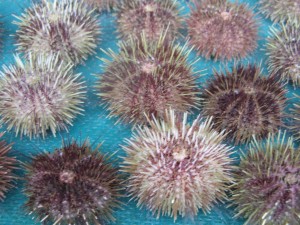
followed population explosions of Strongylocentrotus droebachiensis in
the Canadian Maritime Provinces and the Gulf of Maine in the
1970’s. Large scale harvesting of urchins in Maine and New
Hampshire began in 1987 and expanded rapidly to become the second
largest wild fishery behind lobsters. The harvest of urchins peaked in
1993 at an estimated 20,000 metric tons (MT) and has declined each year
since.
The 2002-2003 yield was about 3,600 MT and fishery regulations will aim
to reduce the harvest to approximately 2,300 MT as a result of an
annual stock assessment funded by the Maine Sea Urchin Zone Council and
a fisheries model by Dr. Yong Chen of the University of Maine in Orono.
The sharp decline in wild stocks of sea urchins throughout the Gulf of
Maine has stimulated a great deal of discussion about various forms of
stock enhancement and aquaculture of urchins. It has become clear that
there will be no sustained fishery of urchins in the northeastern
portion of the Gulf of Maine without a hatchery system, due to
consistent minimal recruitment of urchins in this region.

Friendship International is a business that has been shipping live sea
urchins to Japan for 15 years. The Maine sea urchin is highly regarded
in Japan and the company has gained a reputation for supplying quality
product. The company is able to offer good prices for urchins and this
has meant that we have strong collaborative links with many of the best
divers involved in the fishery. As a key player in the supply chain for
the Maine sea urchin, the company has a strong interest in ensuring the
sustainability of the urchin fishery. Friendship is proposing to
establish a hatchery to supply seed urchins and a network of urchin
aquaculture sites in cooperation with the divers that have
traditionally supplied them.
The spawning and cultivation of larval sea urchins entails a
well-documented set of procedures. The newly reared urchins however are
not suitable for planting out due to susceptibility to predation and
difficulties in settling. Studies have shown that success of planting
out is greatly enhanced if the juveniles are grown out to a size of 10
to 20mm. To grow urchins to this size, they need to be held in nursery
systems, either on land or in suspended structures in the sea. The
latter is likely to be more cost effective but effective holding
systems and methods need to be developed that are economical. The
proposed project will address this part of the cycle by testing
specially designed envelopes with substrates suitable for young
urchins, held in a test tank. The aim will be to devise a system that
reduces the cost of maintenance and promotes more uniform growth rates
among first year urchins. Water currents have been shown to enhance
growth and survival and so these will be induced in the holding tank.
Bags will be fabricated from Vexar plastic mesh folded over like an
envelope with a trough of heavy plastic coated wire as both a spreader
and to support about 100 large mussel shells. About 500 juvenile
urchins (0.5 to 1.0 mm) purchased from a hatchery in Portsmouth would
be stocked into each bag. One hundred such bags will be suspended in a
tank 65ft diameter, 13 ft deep, with circulating seawater from April to
November. During this time it is expected that the urchins will grow to
around 10 mm in size, ready for planting out no earlier than December.
Planting out prior to this time is likely to fail due to crab
predation.
The urchins, once ready for planting out would be sold to fishermen who
own lease sites in the Gulf of Maine. One such fisherman is Mr. Chris
Hill, who has a sea urchin aquaculture lease site in Kittery, Maine.
There is also one site in New Hampshire, the lease for which is held by
Mr. Jay Gingrich, who is also collaborating in the hatchery effort in
Portsmouth with our main consultant on this project, Dr Larry Harris.
RELEVANCE
TO BUSINESS STRATEGY.
It is important that an economical method for growing juvenile sea
urchins is developed in Maine. Once this is achieved, Friendship
International will establish a hatchery presence in the Downeast/
Midcoast Maine area in order to supply the seed urchins to the waiting
fishermen. The other parts of the process are more or less in place;
there are a group of divers ready to apply for aquaculture lease sites
(see attached letter) and supply the final product and the market for
urchins is well established. As previously mentioned, there are already
pilot scale urchin hatcheries in operation in New England and some of
the operators will collaborate on this project. The group expects that
the future urchin aquaculture industry will involve a few hatcheries up
the coast and several urchin lease sites for nursery and ongrowing.
CONTACT INFO:
Nick Brown
CCAR,
33 Salmon Farm Rd,
Franklin,
ME 04634
USA
npbrown@maine.edu
|